A techno-thriller · ten days before totality

THE TOTALITYENGINE

Ten days before the Sun goes out, they put her name on the machine.

A false shipment. A vanished engineer. Eleven seconds of video from a room that does not exist.

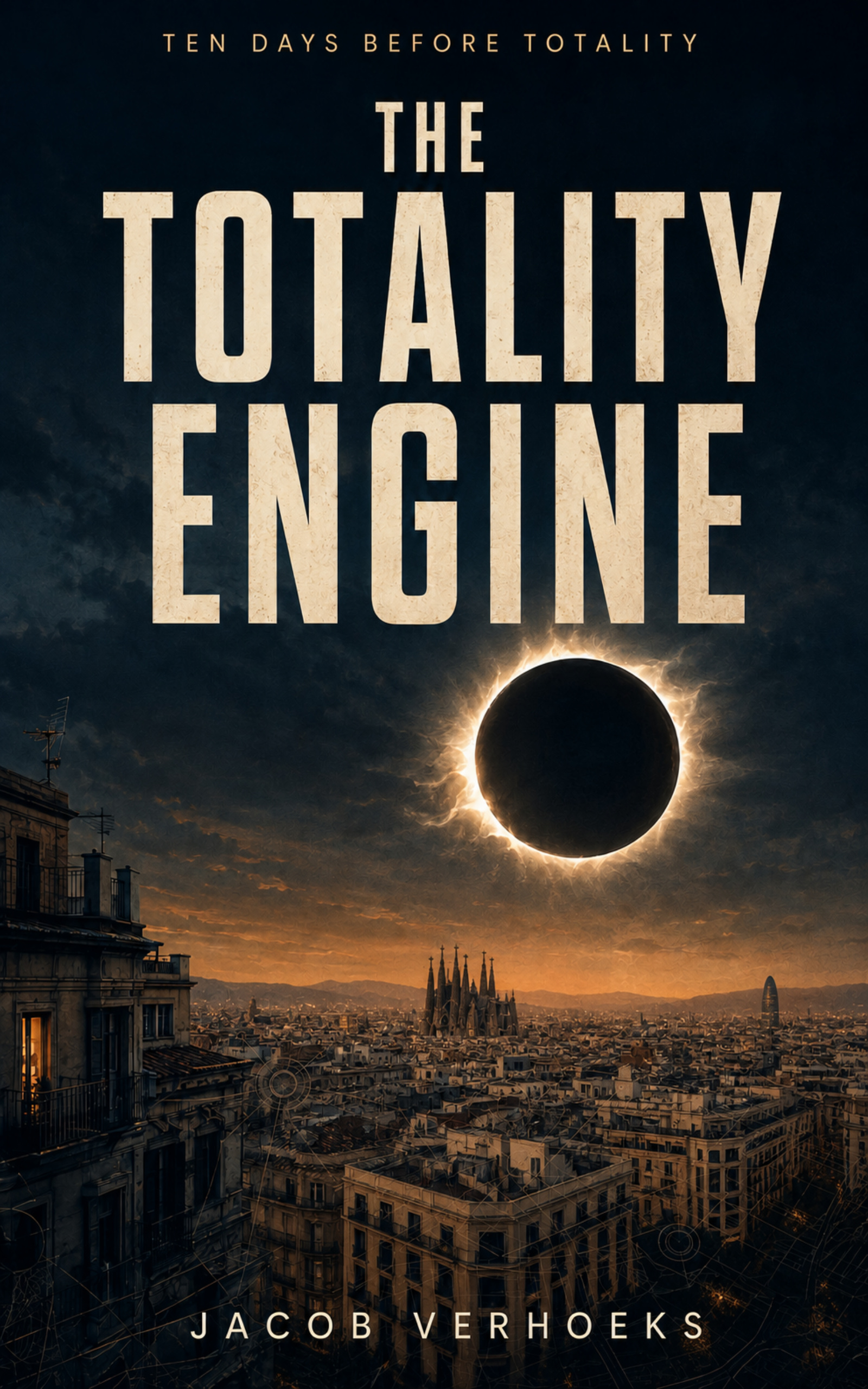
THE TOTALITY ENGINE coverA standalone novel
Scroll
  • Ten days, one deadlineThe eclipse is fixed in the sky. Everything else in the book has to happen before the Moon does.
  • A marriage, not a spyMei and Arnau have no tradecraft. They have a warehouse, a broadcast truck, paperwork, and each other.
  • Evidence computers discardA copied seal, a handwritten ledger, an unfinished sandwich, and witnesses who do not agree.
The story

It begins with the wrong label

Barcelona, August 2026. Mei Zhou runs her family’s import warehouse. Her husband, Arnau Vidal, moves television pictures through systems nobody notices until they fail. Neither of them is a spy.

Then a freight photograph shows eclipse equipment shipped under Mei’s company name. The label is false. That same morning, Arnau’s oldest colleague leaves an eleven-second video and vanishes. In the frame is Mei’s false label on a black case inside a room that does not exist.

To find their friend and clear their name, they follow the things people forget the internet can reveal: an exposed service, a reused certificate, an old public record—and the gaps left when someone has cleaned everything else.

All of it leads toward the total eclipse. The Moon will not wait.
Read it free

The whole novel, no sign-up, no catch.

Free as EPUB, paperback-size PDF, A4 proof edition or one web page, in English, Dutch, Spanish and Catalan. Start with the freight photograph and the label that is not hers.

Download the free editionStandalone · 320 pages · low violence
Behind the scenes

The machinery under the story

The novel keeps the engineering inside the action. The fuller technical account waits until the end of the book; here are only the systems that drive the premise.

Finding what was meant to stay hidden

The public internet keeps traces long after the people behind them believe they have disappeared.

Search engines for machines

Services such as Shodan index public-facing systems rather than web pages. A forgotten hostname or exposed service can reveal that a supposedly nonexistent machine was once online.

Certificates as fingerprints

Reused web certificates can suggest that two unrelated-looking systems share an administrator or history. They are a lead, not proof—the distinction matters in the investigation.

A city as one machine

Traffic control, power, ports, telecoms, and emergency routes do not have to share one brain to share one failure.

The green wave

Coordinated signals can turn separate junctions into a moving corridor. In the story, the pattern becomes a rehearsal—and then a choice.

Negative space

What is absent from logs, maps, and custody records can be more revealing than what remains. Mei and Arnau learn to investigate the gaps.

Eleven seconds

A small timing error is harmless until enough systems agree that it is true.

Clock trust

Modern infrastructure depends on shared time. The thriller turns one repeated offset into a trail through systems that were never designed to be questioned together.

Human fallback

The decisive safeguards are people who notice, refuse, improvise, and accept the cost of stopping a machine that still appears healthy.

Models that can leave the cloud

The story’s fictional chip grows from two real directions in AI: downloadable model weights and hardware designed around how modern models actually move data.

Open-weight models

When model weights are available, a model can run locally instead of behind a provider’s API. That gives the operator more control over privacy, safeguards, logging, and modification—and more responsibility for every one of them.

The possible chip

The chip is fictional. Its premise combines sparse mixture-of-experts routing, lower-precision computation, fast memory, and careful placement of model parts so that only the needed experts are active. Those are real research directions; the compact frontier-scale module in the novel is the leap.

The free library

Read The Totality Engine

  • Standalone novel
  • Spy-tech thriller
  • 320 pages · 29 chapters
  • Barcelona · August 2026
  • Free EPUB, PDF & HTML

The novel is free. Take the EPUB for your reader, the paperback-size PDF for print, the A4 edition for proofreading, or read the whole book in your browser. Dutch, Spanish and Catalan editions are one click away in the corner.

Before you start

Questions readers ask

Do I need to work in technology?
No. Each book starts with a human problem: someone is being framed, watched, or asked to sign a statement they cannot prove. The technical detail explains the pressure, not the plot.
Is this nonfiction?
No. These are fictional spy thrillers. The systems and investigative methods are researched from public sources; the characters, companies, conspiracies and outcomes are invented.
Are the attacks usable?
No. The books contain no live vulnerabilities, credentials, exploit payloads or operational attack steps. The drama comes from evidence, custody and decisions.
Are the books connected?
They share a promise and an author, not a cast. Each is a complete standalone story with a new location. Read them in any order.
The author

Written by someone who has run the systems

Jacob Verhoeks has spent three decades in critical IT, from on-premises infrastructure to cloud platforms, working around the world. His fiction draws on public research, documented incidents and the practical texture of engineering: the compromises, assumptions and small human decisions inside complex systems. The plots are invented. The failure modes are not.

Spy-tech thrillers

Espionage with an audit trail

Three standalone novels, one promise: the conspiracies are fictional, the technology behaves like technology that already exists. Every protagonist is an expert at one ordinary job, forced to decide what their evidence is worth when powerful people need a different story.

AI-generated content label

Transparency note

AI-assisted creation

AI tools helped create and edit this book, including parts of the text and cover artwork. Jacob Verhoeks directed the work, reviewed and revised the manuscript, and is responsible for the final published edition.