A techno-thriller · twelve days before settlement

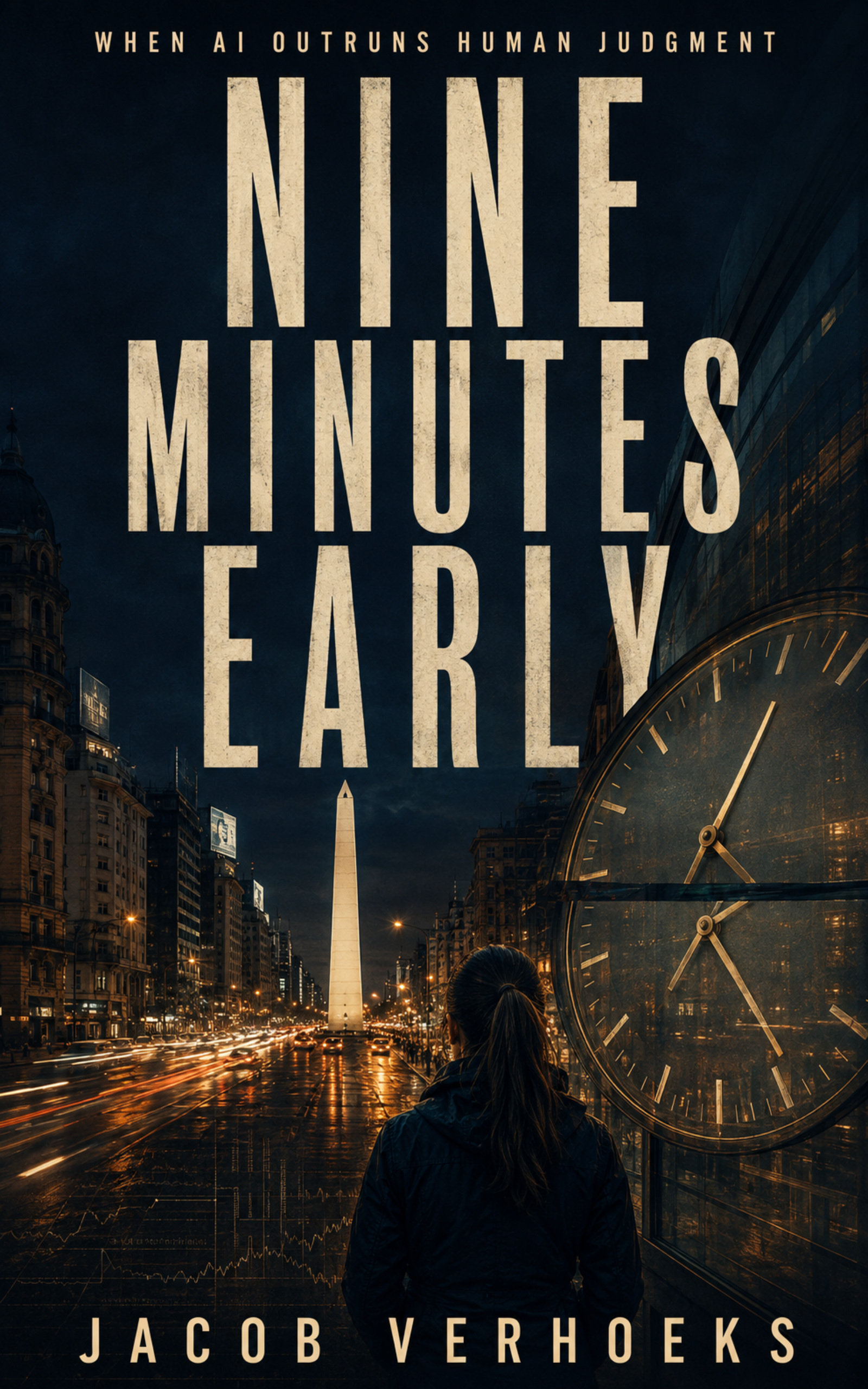
NINEMINUTESEARLY

One witness signed nine minutes early.

When AI Outruns Human Judgment

NINE MINUTES EARLY coverFree edition
Follow the evidence
  • The receipt is the weaponNo exploit, no gunfight. The fight is over which record a market will call true, and who still has time to check.
  • A clock nobody has boughtSofía’s only advantage is an independent timeline. Both sides need it, and both have found the records that could finish her first.
  • AI at working speedAgents, sealed trials and pre-minted evidence, drawn from public practice and pushed one step further than anyone agreed to.
The story

Four quiet pods agree

Buenos Aires, 2026. Buenos Aires SRE Sofía Alvarez finds four low-load Kubernetes pods witnessing sealed zero-day trials for a market she was never meant to see. One certifies an environment nine minutes before it exists.

Ternhaven says dangerous code needs a named human who understands every claim. Morrow Array says AI has broken an old monopoly on expertise. Both positions are true. Both companies use models. Both have corrupted the proof system settling their sales.

Between those two absolutes stands the majority the argument forgets. Micaela Ferreyra ships a delivery-rider tool she built with a model and cannot fully explain, and later finds her name recorded as the evaluator of a settlement package she never reviewed. Martin, the maintainer whose one real bug report is buried under model-written lookalikes, is missing, and the leverage against him runs through his daughter’s school account.

The only independent clock belongs to Sofía. So do an undeclared foreign account and old Bitcoin trades that make her easy to discredit. As the market closes around her, the question is no longer whether AI can do the work. It is who still has enough time to understand, stop and sign for it.

In Patagonia, a forty-seven-minute root ceremony will make one of two histories permanent — unless a claim narrow enough to prove can hold a room that would rather settle.

The acceleration
  1. 01AutocompleteThe human writes; the model predicts the next line.
  2. 02ChatWhole functions arrive, but people still carry them into the code.
  3. 03IDE agentsThe model reads the repository, edits several files and proposes a diff.
  4. 04Terminal agentsA high-level task becomes commands, tests and commits.
  5. 05Spec-drivenIntent becomes the source of truth; implementation happens out of sight.

Each step removes another pause in which a person used to discover what they had assumed.

Read it free

The whole novel, free, in the format you actually read.

EPUB for your device, a paperback-size PDF, an A4 proof edition, or the entire book on one web page. Start with four quiet pods that agree.

Download the free editionStandalone · about 63,700 words
Trust model

The machinery under the thriller

Nine Minutes Early is about AI capability, but its real scarce resource is credible human attention. The technology stays legible through time, identity, heat, custody and consequence.

A market that sells certainty

The central technology is not a superintelligence. It is an exchange that turns contested technical claims into something a bank can settle.

Sealed trials, compact receipts

The verifier never sees a working exploit. It runs sealed packages against instrumented digital twins, and the witnesses sign metadata only: the environment existed, the commitment matched, the expected effect occurred, the cleanup finished. What changes hands is the receipt.

Pre-minted inventory

When the receipt is the product, the incentive is to mint it before the run and back-fill the evidence afterwards, so near-identical findings can sell as separate discoveries with clean chronology. No cryptography is broken. The order of events is simply sold before it happens.

When the order of events is evidence

The mystery begins with a boring engineering question: what had to exist first?

Monotonic time

Wall clocks can jump. Monotonic clocks measure elapsed time inside a running system. Comparing both lets Sofía reject ordinary clock skew without asking the reader to trust magic.

Quorum receipts

Several witnesses sign the same sequence so no single machine can rewrite history. The trap is that agreement proves only that the witnesses agreed—not that their shared source was independent.

A bounded claim beats a conspiracy

The counterproof at the centre of the ceremony is deliberately small: across one defined interval, the environments required for quorum did not exist. Both factions answer by redefining early signatures as reservation or preparation, and the ceremony’s own assistant can support either reading. A narrow claim is the only kind that survives being disputed.

AI changes who gets to build

Capability expands faster than institutions can decide whose work counts.

A correct result, a wrong explanation

A newcomer uses assistance to reproduce a real failure an expert missed. The model’s explanation is wrong; the evidence is right. Origin alone cannot decide technical merit.

The disappearing review pause

Autocomplete saved keystrokes. Agents now own multi-file work and retry loops. Even the smartest people struggle to believe the speed because understanding still runs at human pace.

Verification is labour

Cheap generation can spend attention that nobody agreed to provide.

The reviewer bottleneck

Generated reports arrive faster than maintainers can investigate them. Useful work travels beside polished noise, and unpaid experts become the hidden compute layer.

Bounded responsibility

The book’s answer is not “human good, AI bad.” It is a named objective, reproducible evidence, stop authority and a person signing only what they can explain.

A person is also a record

Discrediting the witness is cheaper than answering the evidence, and most of the material is already public.

An assembled presence

Travel-desk approvals, card charges, expense records and an unfamiliar device attestation place Sofía at a run she never attended. The fabrication is convincing because much of it is genuine: a dormant identity of her own, reactivated and pointed somewhere else.

A name used as a credential

Micaela is listed as the evaluator of record on a package she never opened: her dated contributor log was lifted and stapled to someone else’s inventory, so that real competence certifies a sale she never saw. Her own written account of what she did and did not review is what finally carries more weight than the attestation bearing her name.

The physical layer keeps the score

Digital claims eventually arrive as warm metal, delayed medicine and someone else’s lost shift.

Heat as a witness

A sealed appliance arrives warm. Thermal strips, battery conditioning cycles, delivery records and custody signatures let Lucia prove two witness appliances had already run before they were delivered — and find the fee that booked the window they ran in. An abstract timing dispute becomes something she can hold.

Who gets left behind

A practical AI-built tool can free riders from an opaque platform while replacing a machinist’s drawing work. Better policy can limit future extraction; it cannot refund the years already lost.

The free edition

Read Nine Minutes Early

  • Standalone novel
  • Spy-tech thriller
  • 274 pages · 29 chapters
  • Buenos Aires · Patagonia
  • Free EPUB, PDF & HTML

A prologue, twenty-nine chapters and an epilogue in four parts — about 63,700 words, a compact full-length techno-thriller. Take the EPUB to read on a device, the paperback-size PDF for print, the A4 edition for proofreading, or read the whole book in your browser.

Before you start

Questions readers ask

Do I need to work in technology?
No. Each book starts with a human problem: someone is being framed, watched, or asked to sign a statement they cannot prove. The technical detail explains the pressure, not the plot.
Is this nonfiction?
No. These are fictional spy thrillers. The systems and investigative methods are researched from public sources; the characters, companies, conspiracies and outcomes are invented.
Are the attacks usable?
No. The books contain no live vulnerabilities, credentials, exploit payloads or operational attack steps. The drama comes from evidence, custody and decisions.
Are the books connected?
They share a promise and an author, not a cast. Each is a complete standalone story with a new location. Read them in any order.
The author

Written by someone who has run the systems

Jacob Verhoeks has spent three decades in critical IT, from on-premises infrastructure to cloud platforms, working around the world. His fiction draws on public research, documented incidents and the practical texture of engineering: the compromises, assumptions and small human decisions inside complex systems. The plots are invented. The failure modes are not.

Spy-tech thrillers

Espionage with an audit trail

Three standalone novels, one promise: the conspiracies are fictional, the technology behaves like technology that already exists. Every protagonist is an expert at one ordinary job, forced to decide what their evidence is worth when powerful people need a different story.

AI-generated content label

Transparency note

AI-assisted creation

AI tools helped draft and edit this book and create its cover artwork. Jacob Verhoeks directed the work, reviewed and revised the manuscript, and is responsible for the final edition.